LIVE 🔴 DEMON BOX: Convert Electromagnetic Fields into Music
Explore Demon Box with its creator: electromagnetic sensing, the inductor array, audio and control connections, and the evolution of a new instrument.
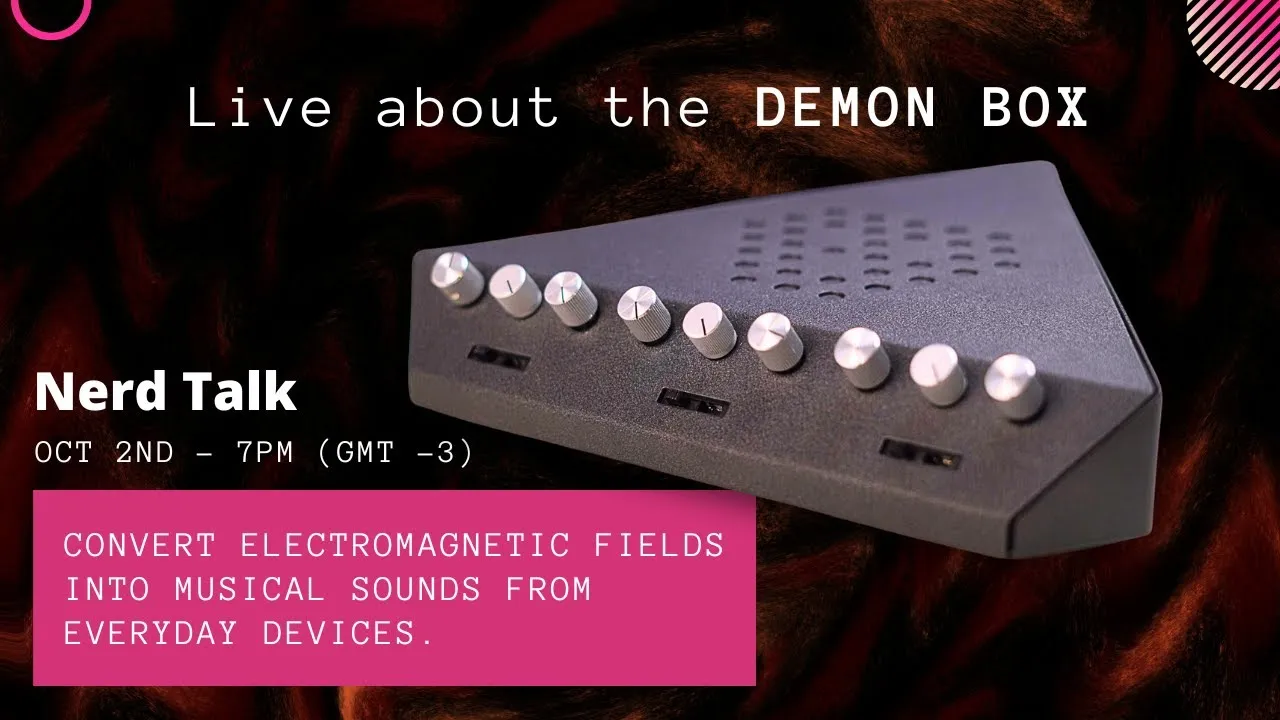
The Demon Box turns electromagnetic activity around ordinary electrical objects into material for sound and control. In this interview, creator Alexandra describes the instrument’s development, its multi-channel inductor array, audio/CV/MIDI connections, and the challenge of presenting an unfamiliar instrument to potential users. This is a product-design conversation, not a schematic or DIY build tutorial.
From guitar pickups to a dedicated EMF instrument
Alexandra’s first experiments followed questions she had while assembling a guitar: why are pickups placed and wired in particular ways, and what would happen if she listened to more of the electrical activity around her? Early wooden prototypes started with amplified guitar pickups and additional circuitry to bring out selected frequency ranges. She tried different wiring arrangements, including putting pickups in series, then shaped the resulting noisy material with EQ, amplification, distortion, and delay.
The instrument changed when she moved from building only what she could physically make to filling journals with shapes and concepts. She says the current triangular form emerged from those drawings and from listening for the sonic and emotional character of each iteration. Alexandra estimates the first drawings are about eight years old; the third wooden prototype shown was one step in a longer sequence. The project evolved with Bren, an electrical engineer, and later Jordan, who works on software and video. Alexandra frames her role as asking “what if?” while collaborators help turn experiments into workable electronics and presentation.
Why inductors, and why 33 of them?
Alexandra distinguishes the Demon Box from a simple pickup in a box. It uses inductors to detect electromagnetic fields without relying on a conventional microphone that also captures air noise and room sound. An inductor’s coil responds to changing electromagnetic activity; the circuitry turns that response into audio. The intended result is access to electrical “noise” already present around devices, rather than sound produced by striking a surface or playing a traditional instrument.
The instrument has 33 inductors arranged across three channels. Alexandra says the arrangement was chosen to create a more spatial, layered result than earlier experiments with one or two inductors. The channels let the player hear different fluctuations at once and route them separately. In the interview demonstration, a wireless computer mouse and a phone are placed near the instrument; the resulting textures include pulses and changing tones. A small transformer is another object Alexandra says produced an interesting sound. Distance changes level and electrical activity affects the result, so objects do not produce predictable notes.
The demonstration is exploration, not a promise that every device will sound musical in the same way. Alexandra’s approach is to capture short moments, listen for useful textures, and process them with effects. One channel can go through one effect chain while another receives different processing; the goal is to turn a raw field response into a playable soundscape.
Outputs, controls, and feedback paths
The version shown has four audio jacks: three mono outputs and one stereo output that can also be used as two mono channels, for five simultaneous audio outputs in total. It also has three CV outputs, three auxiliary audio inputs, five-pin DIN MIDI, and USB-C for power/charging and MIDI. Alexandra says the connections can operate at the same time.
Each of the three control sections has an inductor-volume knob. The middle control blends the auxiliary inputs with the inductor signal, and another control sets auxiliary-signal level. External audio can therefore join the EMF-derived signal; routing outputs through effects and returning processed sound to the auxiliary inputs can create a feedback loop. Alexandra describes this as a way to build cyclical, evolving sound rather than a single pass from input to output.
The video also demonstrates MIDI output controlling a Max patch: MIDI levels from the Demon Box change video effects in Jitter, and the same data can control lighting such as color or strobe. Alexandra says the final version was being developed with more robust MIDI output, including MIDI Note data as well as control information. The interview does not identify a final note-detection or quantization method; Alexandra describes it as an active design question because a continuously changing field does not provide stable, discrete pitches.
A flexible instrument, not a conventional controller
The Demon Box is designed to accept variation rather than map one fixed gesture to one fixed musical result. Alexandra says sensitivity depends partly on how close an object is: moving it nearer makes the response louder, and moving it away makes it quieter. The device can feed effects, modular equipment through CV, a computer through MIDI, or visual tools that respond to MIDI.
That flexibility brings a learning curve. A wireless mouse, phone, transformer, or other electrical object may produce different activity, and the player explores placement, movement, channels, and effects. Alexandra argues that an instrument can be worth learning even if it is not immediately predictable; the interview does not present it as a plug-and-play source of conventional notes.
From personal experiments to a product
Alexandra describes a self-taught, cross-disciplinary path involving woodworking, photography, gardening, and music. Early wooden builds were followed by drawings and then by a team that could advance the electronics, software, and industrial design. She says the project became commercial partly because she wanted to make a sustainable living, but it continued because each iteration revealed new possibilities.
One challenge was explaining the instrument in a campaign video: a device that responds to invisible fields is difficult to demonstrate in a single shot. The team spent time planning the video, visual identity, copy, and press outreach; Alexandra valued direct conversations with musicians and collaborations with artists. She says the Kickstarter campaign had raised more than $100,000 at the time of the interview. That amount and all campaign or delivery plans are historical to the recording, not current sales information.
Alexandra’s advice is to treat emotional and sensory experiences that matter to you as part of instrument design, and to bring in collaborators when a project exceeds what one person can build. The conversation shows the Demon Box as an art instrument whose circuitry, outputs, enclosure, and presentation were shaped through iteration. It does not include a parts list, pinout, or instructions for reproducing the device.