Meet the DRUMBEAM: An Expressive MIDI Controller for Drummers
Discover how Drumbeam combines position, velocity, a multitouch sensor, LED segments and ESP32 browser configuration in an expressive MIDI controller for drummers.
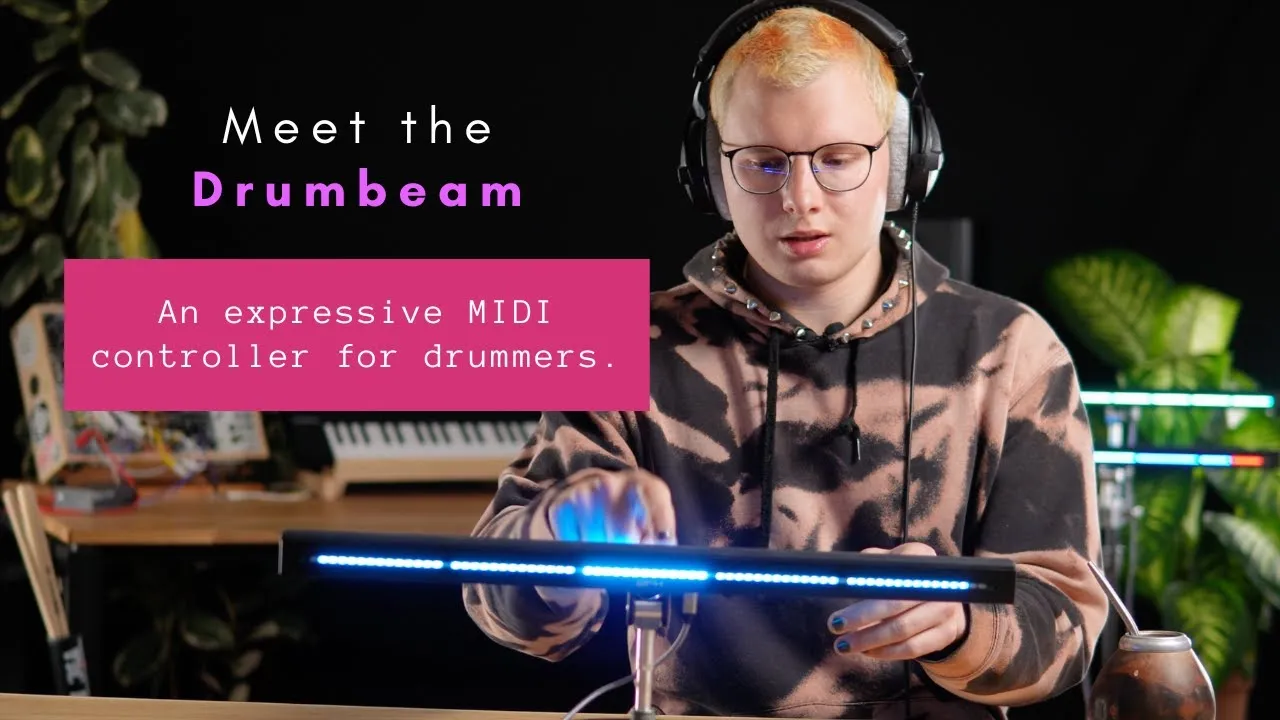
A conventional electronic drum trigger tells an instrument that a hit happened and how hard it was. Drumbeam adds another question: where did you hit? Its continuous playing surface uses position alongside velocity, letting a drummer move through sounds with sticks or hands rather than reaching for a knob.
In this conversation, Sebastian and Flory from AFK Audio explain both the expressive MIDI controller and the work needed to turn an early wooden prototype into a manufactured instrument. The sensor, silicone surface, enclosure, visual feedback and configuration system all developed together.
Position becomes a musical control
Drumbeam is a compact bar with configurable playing segments. A preset can change the number of segments, their size, colour and behaviour. LEDs on both sides make the layout visible, so the player can identify the intended strike region before hitting it.
Position can produce MIDI Control Change data. That gives it a role beyond selecting a drum note: it can crossfade between samples or modulate a synthesizer, drum machine or DAW parameter as the strike position changes. Velocity supplies information about the impact itself.
A receiving instrument still needs a useful mapping. For example, a positional value can be assigned to a sound parameter that has a meaningful range, while the percussion action triggers the sound. The musical result comes from that assignment and the player’s control of the surface.
A MIDI instrument for an existing drum setup
Drumbeam does not contain its own sound engine. It sends MIDI to a computer or external hardware. The connections discussed include USB MIDI and TRS MIDI input/output, with USB-C also used for power and programming.
The instrument can sit on a desk stand or attach to a conventional cymbal stand, making it possible to add it to an acoustic drum setup. It is intended for sticks and also responds to hands. Sebastian describes using it with a drum machine for electronic percussion and exploring a modular setup.
This matters because a drummer’s controller has to fit physically into a playing position. A theoretically expressive sensor is less useful if the mount moves, the target is hard to see or the rebound feels wrong.
Why the first sensors had to change
The early prototype used commercially available Flexipot sensors. The team stacked two sensors to obtain position and pressure information, but the arrangement was limited to a single touch. That becomes restrictive when two sticks or hands should act independently.
AFK Audio then developed a custom sensor for multiple simultaneous positions and independent pressure detection. The creators do not disclose its internal construction in the interview, because they were pursuing patent protection at the time. The discussion describes a patent application process, not an independently confirmed granted patent or an open sensor design.
The team also talks about gestures such as holding or squeezing as possibilities enabled by that sensing approach. Treat those development possibilities separately from the exact functions demonstrated in a particular preset.
Rebound and enclosure are part of the instrument
The physical prototypes went from wood to a metal bar, then added visual feedback. One early version used a Teensy and required hours of soldering and packing electronics into a narrow tube. A prototype that could be played was still difficult to assemble repeatedly.
The later design discussed in the interview uses an ESP32, redesigned electronics, LEDs on both sides and a silicone playing surface. The enclosure is CNC-machined aluminium. The team describes several mechanical iterations to make the components fit and make construction practical.
Flory’s thesis work included asking drummers about surface characteristics such as material, stiffness and rebound. Those choices affect whether a stick returns in a useful way and how the controller feels under repeated playing. They are instrument-design decisions rather than cosmetic finishing touches.
Mounting required similar attention. Percussion clamps and stand attachments have different dimensions, so the mechanical engineer worked on an attachment that could fit a range of setups. Manufacturing also meant sourcing the silicone, enclosure, screws and other small parts consistently.
Configure it through the ESP32’s local website
A bar without a display still needs a way to set notes, channels and segment behaviour. The initial prototype used hardcoded settings. Requiring a computer and USB connection for every edit would have limited how easily a musician could change the layout.
The ESP32 runs a configuration website and creates its own Wi-Fi network. Connect a phone, tablet or computer to that network and open the interface in a browser. The settings discussed include segment count, colours, MIDI channels and CC numbers. The web interface runs through the instrument rather than requiring a dedicated installed app.
Wi-Fi here provides the configuration connection. The interview’s MIDI connection discussion uses USB and TRS; the fact that the chip includes wireless hardware does not by itself establish every wireless MIDI mode as a finished feature.
Firmware updating is also discussed through USB-C with a drag-and-drop workflow. Use the instructions for the actual device revision when updating, since the interview records the state of development in November 2024.
From a personal project to AFK Audio
Sebastian began by experimenting with piezos and Arduino boards as a drummer. Giving an early prototype to a music student led to interest from the student’s professor and more versions of the instrument. Flory joined through engineering thesis work on calibration, and the team expanded to include mechanical and marketing expertise.
Showing the instrument at Superbooth and seeking feedback helped expose needs beyond the original player’s habits. Government funding gave the team time to develop the product and prepare manufacturing. The Kickstarter and shipping plans mentioned in the conversation are historical plans from that stage, rather than current availability claims.
The strongest lesson for a maker is to test the whole playing experience with other musicians. Sensor resolution matters, but so do visual targets, rebound, configuration and the time it takes to assemble another unit. Drumbeam is interesting because those decisions support an expressive percussion gesture together.