LIVE about the MIDIHEX: an isomorphic, velocity-sensitive, DIY MIDI controller
Discover MIDIhex, an isomorphic MIDI keyboard with Hall-effect key sensing, velocity, microtonal layouts and custom mechanical design.
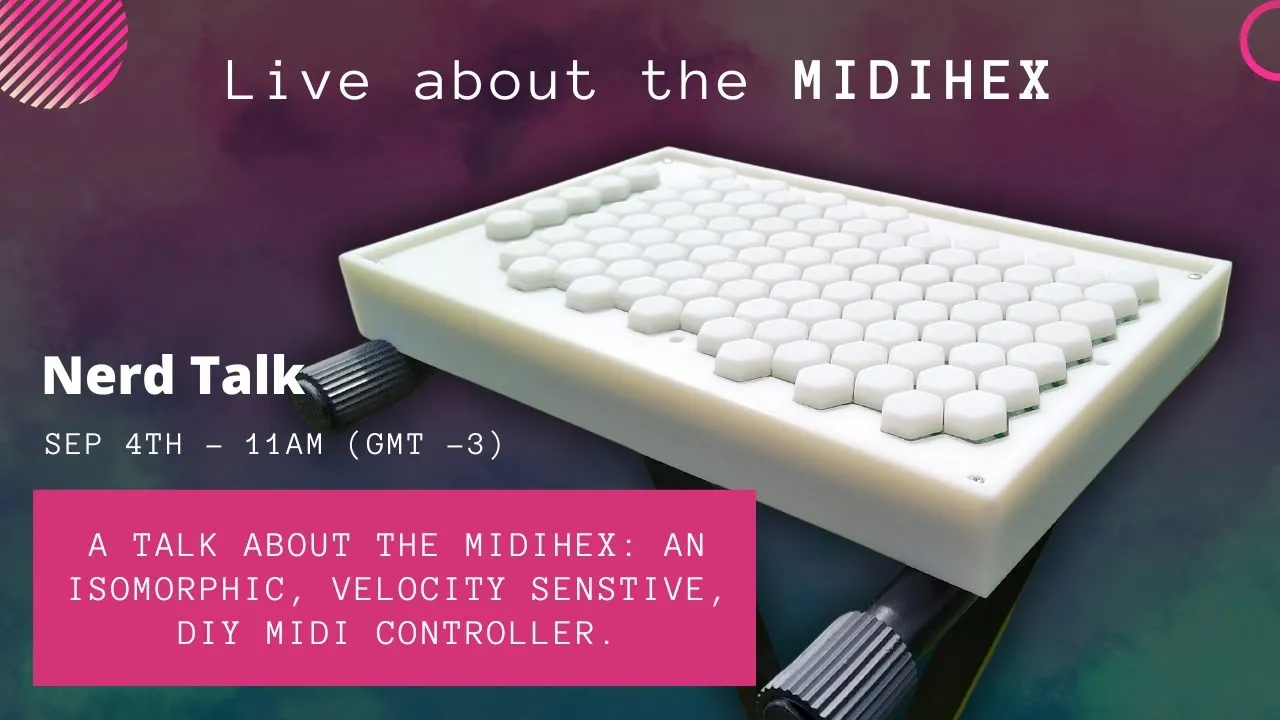
MIDIhex is Ben Glover’s attempt to bring an expressive, velocity-sensitive playing surface to a hexagonal isomorphic keyboard. The interview connects the design to the discontinued C-Thru Music AXiS-49 and then follows the practical problems of sensing key travel, scanning many sensors, and making a custom enclosure playable. It is a project conversation, not a complete build guide.
Why choose an isomorphic hex layout?
On a conventional piano, a scale or chord has a different fingering in different keys because of the white and black key arrangement. An isomorphic layout repeats the same interval pattern wherever the player starts. Ben describes playing a scale from any hexagon with the same fingering; the Axis-style harmonic table also places major triads in a consistent three-key shape and minor triads in a related shape.
Ben’s interest came from collecting unusual MIDI controllers and from the Axis 49, which was no longer readily available. He mentions related layouts and instruments, including Wiki-Hayden button accordions, the Streak board, and Intuitive Instruments’ Dala and Xkey. MIDIhex is a re-creation and reinterpretation of that style of controller, not a conventional piano keyboard. Ben has begun adding alternate layouts using a function key; in the demonstration, holding the function key and pressing a note key changes the harmonic table’s orientation. Microtonal layouts are a future interest, not a completed feature.
Continuous key sensing with Hall-effect switches
A standard SPST button is simply on or off and cannot report how far it is pressed. Ben first explored SPDT switches that break one contact and make another, but found the available switches too stiff to play comfortably. The solution uses gaming-keyboard Hall-effect switches: a magnet moves with the spring-loaded key stem, and a Hall sensor reads its position as an analog value.
The key switches Ben names are Lekker L60 and L45 models. The sensor he tested is the OH49E, including a surface-mount variant. Each key’s magnet moves closer to or farther from its sensor as the key travels. Firmware reads the continuous position and derives MIDI note velocity from it. Ben says he has not yet spent enough time practicing to make a musical performance demonstration; the interview focuses on sensing and prototyping.
The PCB uses seven 74HC4067 analog multiplexers. Each multiplexer can select one of 16 analog inputs using a four-bit address, allowing a Teensy 4.1 to scan the sensor array. The current single-tier arrangement supports the 98 playable keys of this Axis 49-inspired version and uses the available analog inputs. A larger 192-key Axis 64-style version would require a two-tier multiplexer design, which Ben had not implemented at the time of the conversation.
Ben reports no magnetic interference between adjacent keys in his current layout. He credits collaboration: an electronics designer helped with the PCB and circuit, another freelancer designed the case, and ChatGPT helped with code. He is explicit that he is not an electronics engineer and learned through the project.
The case, key feel, and serviceability
The instrument combines a custom PCB, Teensy, Hall switches, a separate keyboard plate, and a 3D-printed resin enclosure. The switches are plastic and cannot be soldered like conventional mechanical switches. They clip into a plate; the plate and PCB are then held together with spacers and screws. Keycaps use a Cherry MX-style cross stem. O-rings under the caps reduce the sharp key clack, though Ben says the upward return still sounds clicky.
The case went through multiple iterations. Version one used a tray with a bezel and exposed top screws. Its resin mounting posts crumbled when Ben tried to install heat-set inserts; he learned those inserts were unsuitable for that resin. Version two reverses the enclosure arrangement and uses captive nut traps so nuts cannot rotate while screws are tightened. The keycaps and case are still being refined for fit, feel, and a sturdier finish. Although switches can technically be replaced without soldering, replacement requires opening the instrument and separating the plate-and-PCB assembly; Ben says it would be a hassle rather than a quick hot-swap.
MIDI, microtonality, and possible future versions
The interview demonstrates consistent scale and triad shapes and an alternate 90-degree harmonic-table orientation. Ben has not implemented microtonal layouts. He explains why a hexagonal layout is useful for alternate equal divisions of the octave (EDO): a conventional 12-note keyboard does not naturally preserve scale fingering if consecutive keys are reassigned to, for example, 31 divisions. He points to software such as Scala for microtonal tuning, but does not demonstrate MIDIhex with a particular microtonal setup.
Ben is exploring whether a future version might include an onboard sound engine, allowing headphones without a laptop or phone. He discusses Daisy Seed, Axoloti/Caselotti, a Pico-based audio board, Bela, and Raspberry Pi as candidates. He finds Daisy powerful and affordable but difficult for a non-specialist C++ programmer; he describes Raspberry Pi as more powerful but slower to boot and harder for him to integrate. These are his evaluations during exploration, not a selected implementation.
Sharing the design and what remains unfinished
Ben estimates a finished unit might cost around £300 to build and would need to sell for roughly £400, though he is uncertain whether enough buyers would want it at that price. He is interested in selling affordable PCBs and publishing STL files so others can print the enclosure, but wants to complete a version he is personally satisfied with first. He says he intends to make the code open source; the interview gives no repository or release date.
A 192-key version and an onboard sound engine remain future goals. The immediate work is making the 98-key prototype reliable, comfortable, and presentable. The interview’s useful contribution is its concrete account of combining a repeatable note layout with analog key-travel sensing, and of how enclosure details can take longer than the electronics.
For another view of how playing gestures become MIDI data, compare the expressive-controller overview. The common question is which movement the sensor measures and how the receiving instrument uses it.